From relearning life’s basics to rebuilding strength step by step, Mun Chong’s journey is a powerful story of resilience, patience, and determination.
After facing a life-changing medical condition at a young age, he had to start over and relearn fundamental skills. Today, through persistent rehabilitation and the support of dedicated therapists and staff, he continues to make steady progress in his recovery.
In this interview, Mun Chong shares about his daily life at Singapore Cheshire Home, his rehabilitation routine, and how he stays motivated driven by the mindset of “If not now, then when?”
Despite being over 60 years old, he embraces challenges with courage and an open heart, reminding us that it’s never too late to try new things and keep moving forward.
Read more about his inspiring journey and the strength drawn from small steps of progress.
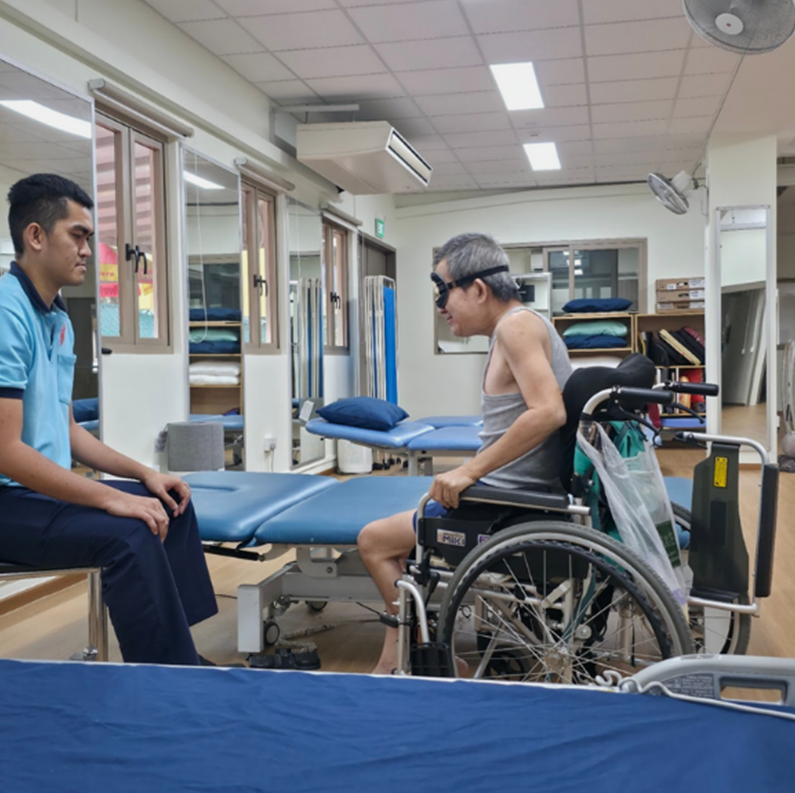
Mun Chong getting ready for his regular exercise with help from Therapy Aide (TA) Jorell.
Q1. How long have you been a resident of SCH? How has your condition affected your daily life?
I moved into Singapore Cheshire Home in November 2019, so it’s been about five years now. Not long after I settled in, COVID-19 struck and things got pretty chaotic for a while with lockdowns and quarantines, but thankfully that period has passed.
Earlier in my recovery, I had to relearn basic things like walking, talking, and even sitting up. It’s changed my daily routine a lot, and I’ve had to take things slower and be patient with myself.
Q2. Could you please share more about your medical condition?
When I was 16 years old, I was struck by a stubborn fever that refused to go away. Despite countless visits to the doctors, nothing seemed to work. Eventually, I went to Tan Tock Seng Hospital (TTSH) where I was diagnosed with encephalitis—inflammation of the brain.
TA Jorell helps Mun Chong position his neck for proper posture during his spinal correction therapy.
TA Jorell monitors Mun Chong as he performs his standing exercises, focusing on balance and stability.
Q3. What is your typical rehabilitation session like?
My Occupational Therapist (OT), Mr Simon, has designed a five-day-a-week programme that focuses on building my muscle control, balance, and strength. Each session lasts about an hour and includes a rotation of three exercises. These exercises involve standing, sitting, and maintaining balance on a vibration platform.
Q4. What is one improvement you’ve noticed in yourself since starting the rehabilitation programme?
I have gained, better control of my movements, greater stability, and a renewed sense of strength in my body. Every small improvement felt like a victory, a sign that all my hard work was paying off.
Mun Chong reads the newspaper for leisure and to stay informed on local and global events
Mun Chong preparing to use the Galileo vibration platform, a therapy machine that helps improve balance.
Q5. How have the therapists or staff supported you during your journey?
All the staff have been very supportive, always ready to lend a hand or offer a kind word when I need it most. The therapists, in particular, have played a very important role in my journey. Their care, patience, and dedication have made a real difference in my recovery and progress.
Q6. Is there anything you want to achieve at the end of your rehabilitation?
As someone over 60 years old, I often find myself reflecting on life and its many twists and turns. There’s a saying that rings true for me, “If not now, then when?” This pushes me to not be afraid to try new things especially since I still have the strength.
Life is unpredictable, and I’ve learned that lesson first hand. No matter what life throws our way, there is always a way forward.
Mun Chong and Resident Norsuwali chatting while on duty. At SCH, A team of assigned residents help with concierge duties to welcome visitors.